
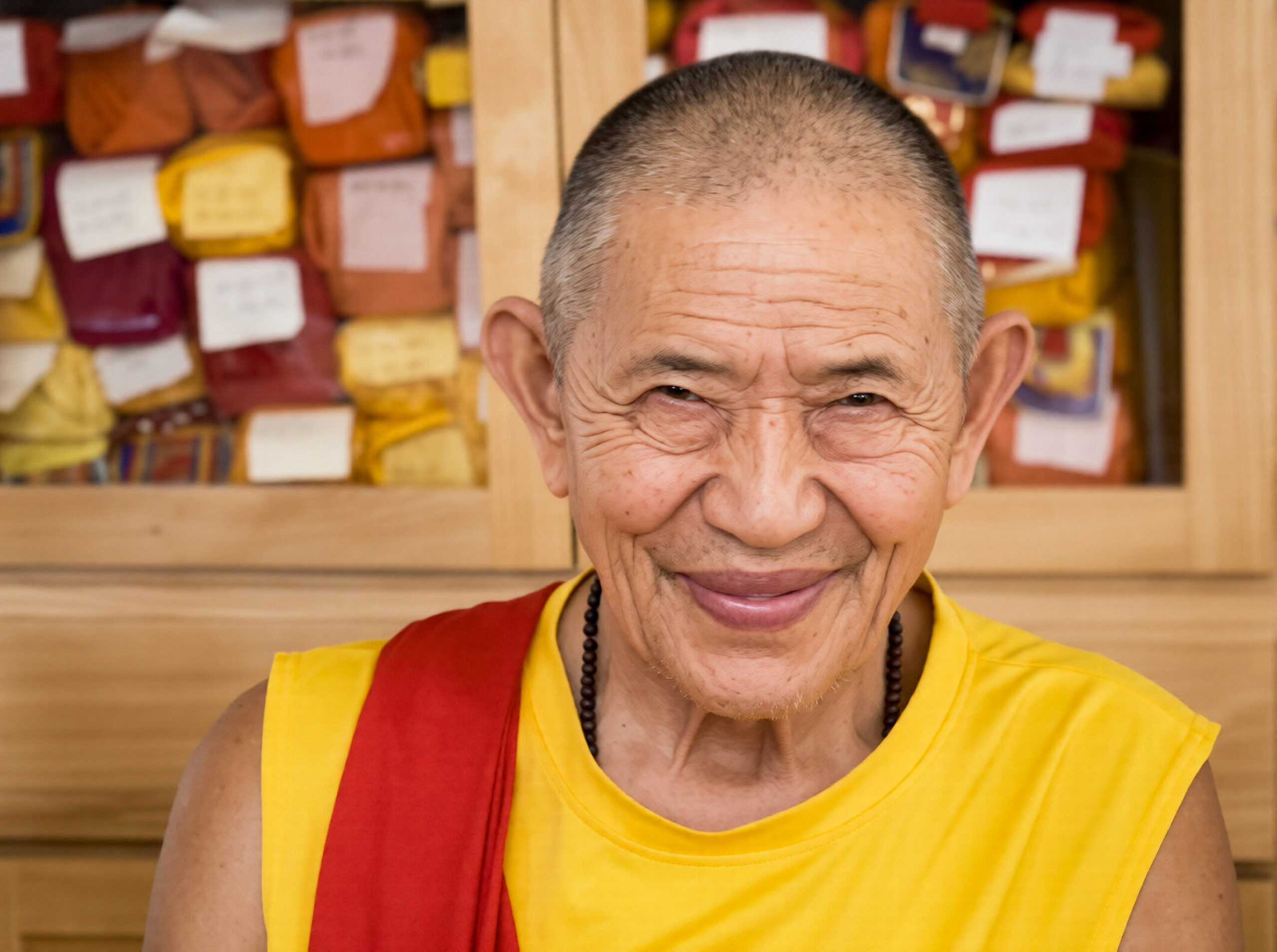
In the collection of Jigten Sumgön’s special instructions called the Single Realization (Gongchig) he teaches: “Buddhas are the very embodiment of bodhichitta.” In the time that I’ve gotten to know Garchen Rinpoche, it’s hard not to see how he directly embodies bodhichitta at all times. I think this is apparent to almost everyone. While there are many subtle aspects to bodhichitta, in essence it is the enlightened mind that embodies the wish and action to attain enlightenment for the benefit of all sentient beings to also help them attain enlightenment and ultimate freedom from suffering.
It’s amazing that Garchen Rinpoche, a beautiful embodiment of bodhichitta, is ninety years old and is still expressing his love for others and guiding us on the path. When I heard that he was recently sick, like many of you, I wondered what I could do to help. Over the last couple of months that he has thankfully been recovering, I’ve been trying to practice his own recent instructions and contemplate a number of things that he taught over the years. What follows are a few things I thought might be of interest to others as well.
One thing that Garchen Rinpoche taught on recently when I saw him last was about long-life ceremonies and prayers for teachers. In particular he taught: “If everyone protects the great samaya of loving-kindness and meditates with immeasurable love towards all sentient beings, this is the best long life ceremony for the lama. Therefore, please be certain about this.”
At another time in years past, when I was translating for a small group, one of his students asked: What practice can we do and how can we offer ourselves to extend Garchen Rinpoche’s life? Garchen Rinpoche replied: “When you meditate merging our minds inseparably and cultivate limitless love and bodhichitta for all sentient beings, I will never die, because we have become one and the same. I will live on in you.”
In both contexts the essential message is love. When we merge our minds with that love and bodhichitta that he and other great beings embody, I think it creates the auspicious circumstances for the best outcomes in this temporary impermanent life and also the basis for our collective ultimate attainment of Buddhahood beyond temporary suffering.
Bodhichitta Prayer and its Secret History
JANG CHUB SEM CHOG RIN PO CHE
Bodhichitta, precious mind,
MA KYE PA NAM KYE GYUR CHIG
Where unborn, may it arise.
KYE PA NYAM PA ME PAR YANG
Where born, may it not decline,
GONG NE GONG DU PEL WAR SHOG
But higher and higher thrive.
One of the first things that I saw and heard from Garchen Rinpoche after he began to recover recently from being sick was a video where he was reciting the famous bodhichitta prayer. It’s a prayer that I’ve known, recited for decades, and translated in various ways many times, but hearing it again this time made me want to know it still more.
While the prayer is sometimes traced back to the Indian master Shantideva and his Entering the Way of the Bodhisattva teachings, it ultimately isn’t found there. Without going into too many details about my search for the origin of this prayer, a short version is that I found that the Bhutanese professor Dorji Wangchuk had begun a search with his dissertation in 2007 and had recently written an update in 2024 about the earliest source of the bodhichitta prayer that he could find: https://sudharmablog.wordpress.com/2024/11/15/in-the-quest-of-a-source/
In short, he found that Sönam Zangpo (1341-1433) had written an early version of the prayer down in an arrangement of the Sixteen Principles of the Fasting Ritual in the Tradition of Bhikshuni Palmo, composed by Sönam Zangpo (smyung bar gnas pa’i cho ga de nyid bcu drug dge slong ma dpal mo’i lugs jo gdan bsod nams bzang po’i mdzad pa)
The date of this text was 1366 and it is part of the Eleven-Faced Chenrezig Tradition that the Indian mahasiddha nun, Gelongma Palmo, received from Chenrezig himself. The colophon of this text clued me in to how Sönam Zangpo had received this transmission from his teacher, Gyalse Thogme Zangpo.
Gyalse Thogme Zangpo (1295-1369) is the famous author of the Thirty-Seven Bodhisattva Practices, or Thirty-Seven Things that Bodhisattvas Do. He also composed an incredible and widely famous commentary on Shantideva’s Entering the Way of the Bodhisattva called the Ocean of Eloquent Explanation. Long story short, after delving deeply int Thogme Zangpo’s collected works I found what could very well be the earliest version of the bodhichitta prayer. Not only that, but I was able to track down a number of similar statements by Thogme Zangpo in his other works that make me think that he could likely be the original author.
The potentially earliest version of this prayer is found in the wonderful recent 2018 edition of Gyalse Thogme Zangpo Pal’s Collected Works (rgyal sras thogs med bzang po dpal gyi gsung ‘bum).
The specific text is called the Sadhana of the Great Compassionate One (thugs rje chen po’i sgrub thabs). It is part of a wider collection of practices that presents a lot of Gelongma Palmo’s Chenrezig tradition. Many of these other Chenrezig texts I have found in the Tibetan Tengyur translations from Indian source materials. However, this four line prayer is not among them.
Likewise, by looking through a lot of Thogme Zangpo’s other works, I’ve found that he uses similar phrases when talking about bodhichitta, particularly for example in the Notes on Mind Training and Notes of Direct Instruction (blo sbyong zin bris dang dmar khrid zin bris) recorded by his student Palden Yeshe:
“If you have received other instructions of the definitive meaning on the means for generating ultimate bodhichitta where it has not arisen, and for it not to decline where it has arisen, but to increase, then there is nothing beyond that to teach here.” (don dam byang sems ma skyes pa bskyed pa dang / skyes pa mi nyams shing ‘phel ba’i thabs nges don gyi ‘khrid gzhan thob na / ‘dir yang de bas lhag pa bstan rgyu med)
Also in the same texts he teaches:
“In brief, these are symbolic methods that cause meditative absorption to arise where unborn, and where born to increase higher and higher.” (mdor na ting nge ‘dzin ma skyes pa skye zhing / skyes pa gong nas gong du ‘phel bar byed pa’i brda thabs rnams so)
There are a number of other similar examples that make me confident that there is a strong chance that Thogme Zangpo was indeed the original author of this bodhichitta prayer that became famous throughout Tibet and now the world. At the very least, he was instrumental in transmitting this tradition of the bodhichitta prayer alongside his commentary on Shantideva’s Entering the Way of the Bodhisattva and the Thirty-Seven Practices of the Bodhisattva. It kind of makes this prayer even more powerful to me, knowing that it shares a potential origin and at least kinship with an author that is so dear to my own root teacher Garchen Rinpoche.
Garchen Rinpoche taught that once bodhichitta is truly born within us, we can never die, because that bodhichitta mind will always be growing with love for all beings until we attain complete enlightenment. In this way, I like to recite the bodhichitta prayer thinking about Garchen Rinpoche.
Bodhichitta Prayer and Early Version from Thogme Zangpo’s Collected Works (10-06-26)
Four Applications of Mindfulness
One thing that Garchen Rinpoche asked for his students to do as a method to help heal him was to study and discuss the four applications of mindfulness. On one hand, this is a pretty unique way to request healing. On the other hand, if our minds are all interdependently connected and the ultimate source of all our experiences in this world, it makes perfect sense that cultivating mindfulness and virtue to heal our own minds from afflictive emotions and suffering would likewise have a positive effect all around, particularly with Garchen Rinpoche who introduces us to the nature of mind and its interconnectedness with everything.
Along those lines, this has led me to study the teachings by Jigten Sumgön (1143-1217) on the four applications of mindfulness that occur in his Profound Dharma Collections.
Three Passages on the Four Applications of Mindfulness by Jigten Sumgön (10-06-26)
In these Jigten Sumgön says: “Enlightenment is the very essence of the four applications of mindfulness.”
He also says:
“At the conclusion of the profound dharma teachings that the Protector of Beings, Phagmo Drupa, gave to the assembly, he would say:
However important those teachings may be, in the end you lie down upon your final bed. Your final nourishment is a single drop of water. When your relatives and loved ones have gathered around you, and you are taking long and short breaths, there is no refuge and nothing to rely upon other than the dharma. When the time of death arrives, no companion can accompany you. Neither children, spouse, relatives, friends, possessions, nor provisions can help you. What, then, can help? Apart from helping yourself on your own, there is no other protector, refuge, dwelling, or ally.
Ananda asked his tathagata teacher Shakyamuni:
When you, teacher, have passed into nirvana, what should we take as our shelter and support?
His teacher replied:
Though there is no other shelter or support, make yourself your own shelter.
Make yourself your own refuge, protector, and ally.
Your refuge, protector, and island are not someone else.
What, then, is the method by which we become our own shelter? It is the four applications of mindfulness.“
He also says:
“For ultimate and relative bodhichitta,
The way of meditating on all the antidotes,
Faults, and adverse factors
Is in relation to body, mind, feelings, and dharma.
This is using the four applications of mindfulness
As antidotes to grasping at self and so forth.
Like placing water within water,
Rest in complete nonreferentiality.
All thirty-seven factors conducive to enlightenment
Are likewise practiced in the same way.
Within the ocean of nonconceptuality,
Like bubbles in water,
Rest simply in how things truly are.
This is similar to the realization of the teacher Shakyamuni.”
Since all suffering is taught to arise from grasping at a self and the four applications of mindfulness are the antidote to that, they really are the ultimate practice for healing.
Chakrasamvara Secret Mantra – Four Applications of Mindfulness
For those that are interested, there is also the way of integrating the understanding of secret mantra with the four applications of mindfulness. In the sutra tradition we cultivate renunciation through meditating on the impure aspects of the body. In the tradition of secret mantra however we recognize the body as being the pure divine form of our Buddha nature. When asked about this Jigten Sumgön himself taught:
“Through the close application of mindfulness of our impure ordinary body, attachment and clinging are abandoned. Through meditating on our body as the deity, attachment and clinging to the ordinary is also reversed. The close application of mindfulness of the body as a substance of impurity and of meditation on the body as a deity are both methods for generating meditative absorption in which the senses do not follow after their objects. Since there is no attachment within, the way they generate qualities is the same. Thus, both are methods for realizing coemergent wisdom.”
For more detailed instructions on the four applications of mindfulness in the context of secret mantra, here is the Special Meditation on Purity through the Four Applications of Mindfulness from Illuminating Light of the Coemergent Sun and Moon: A Complete Explanation of the Five Coemergent Deities of the Glorious Chakrasamvara by Lamchen Gyalpo Rinpoche.
Longevity Buddhas – Tara, Amitayus, Padmasambhava, and Mandarava
To conclude the main post I’d like to share two practices that are meaningful to me, have a connection with Garchen Rinpoche, and have an auspicious connection to long-life.
Many of us have been doing the practices of White Tara and Amitayus for the long-life of Garchen Rinpoche. There are also some other special forms of these practices that I thought might be of interest to others as well. The Nectar Moonbeams is part of a very special pure vision that Rinchen Phüntshog (1509-1557) received from White Tara. The Lifeforce Lama of Devotion from the same cycle can be found here in the section on Guru Yoga Practices. The Nectar Moonbeams is the longevity practice from this cycle where we meditate upon Tara and Amitayus in union in our crown chakra. When we do this practice as a healing practice for others, we meditate that the one we are seeking to heal is inseparable from our own body, speech, and mind as we invoke healing through meditating upon Tara and Amitayus within us. Garchen Rinpoche himself used to teach me from these instructions and has carried the physical text of this pure vision on his body for multiple lifetimes. I included a special version of the mantra for Garchen Rinpoche in the translation.
Nectar Moonbeams – White Tara Pure Vision Longevity Sadhana Instructions (10-06-26)
Next is the Yangzab Chidag Zilnön Overwhelming the Lord of Death Daily Practice, which also comes from Rinchen Phüntshog’s treasures. This is a short, condensed arrangement by Nyindzong Tripa Döndrub Chöwang of a longer version by Rigdzin Chökyi Dragpa. In the past, Garchen Rinpoche generously bestowed many teachings based on this longevity cycle. It is also a practice that the lamas at the Garchen Institute have done recently for Garchen Rinpoche’s long life. In this practice we see ourselves as Padmasambhava Amitayus in union with the immortal Mandarava. We have the Amitayus deities of the five families in our five chakras. Through this practice, we invoke the longevity power of all samsara and nirvana.
Yangzab Chidag Zilnön Overwhelming the Lord of Death Daily Practice (10-06-26)
By the power of precious bodhichitta, mindfulness, White Tara, Amitayus, Padmasambhava, Mandarava and all the longevity Buddhas and bodhisattvas of the three times and the ten directions, may Garchen Rinpoche live forever.
Two New Kalachakra Free Translations, Three New Publications
There are a number of new and exciting translations of the Kalachakra generation stage practice as well as the famous completion stage system known as the Six Branches of Yoga.
First here are two free translation offerings of Kalachakra sadhanas for dedicated practitioners who wish to learn more about and practice this tradition. The first is an incredible terma treasure by the Drigung Tertön Ösel Dorje.
Ösel Dorje’s Mind Treasure – Glorious Kalachakra Secret Sadhana (10-06-26)
The second, called the Source of the Two Benefits, is a coemergent Kalachakra sadhana practice composed by Rigdzin Chökyi Dragpa (1595-1659) and arranged by the second Drigung Chungtsang, Könchog Trinle Döndrub Chögyal (1704-1754). Its concentrated structure presents the essential elements of the generation stage in a practical form for recitation and meditation.
Source of the Two Benefits – Coemergent Kalachakra Sadhana (8-02-26)
Also, here are three new Kalachakra publications available in the bookstore now. These focus on the special Kalachakra completion stage inner yogic practices renowned as the Six Branches of Yoga.
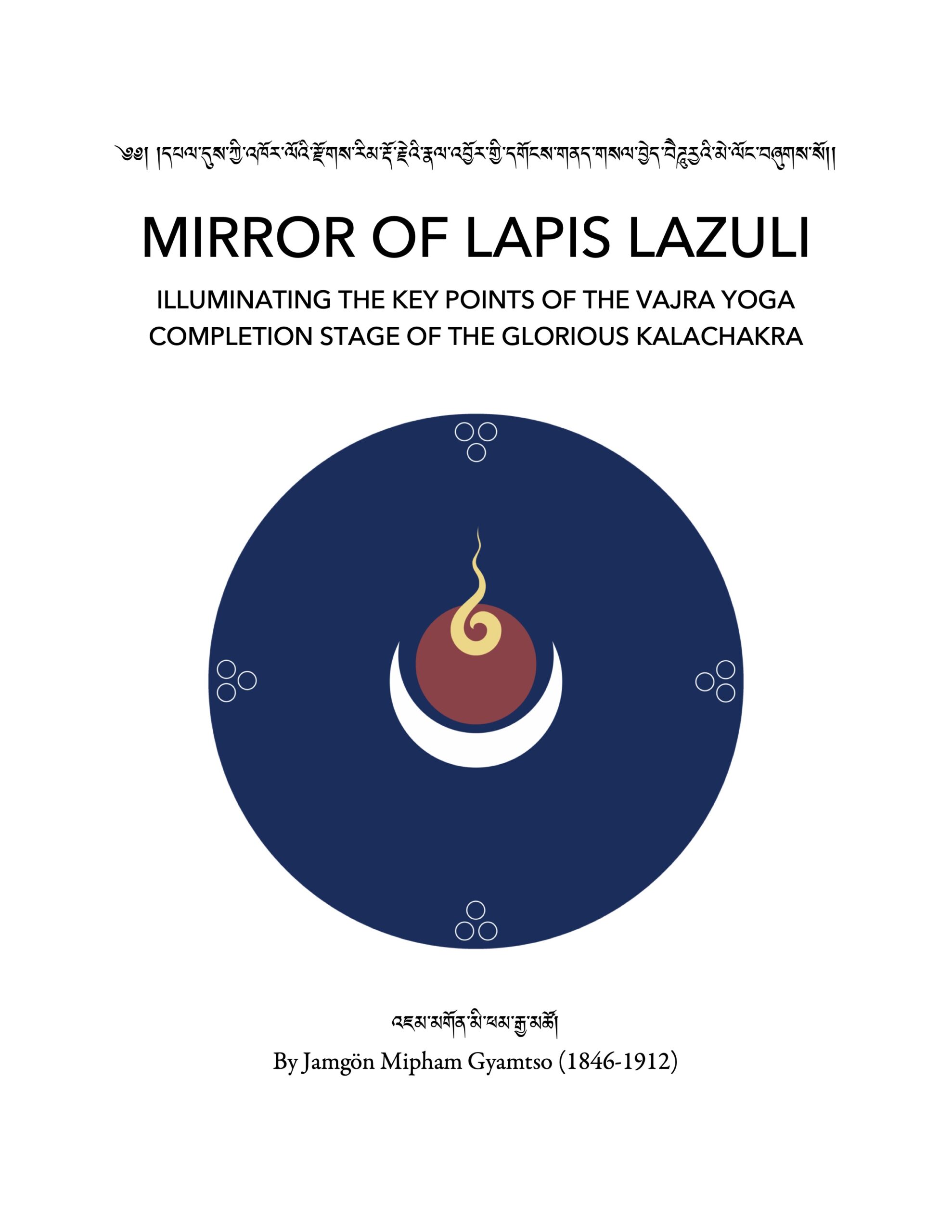
Mirror of Lapis Lazuli – Kalachakra Completion Stage Collection
The Six Branches of Yoga are the completion stage of the glorious Kalachakra, the Wheel of Time. The Mirror of Lapis Lazuli: Illuminating the Key Points of the Vajra Yoga Completion Stage of the Glorious Kalachakra by Jamgön Mipham Gyamtso (1846–1912) is a complete manual for this path, written by one of the greatest masters of the Nyingma tradition near the end of his life. This collection presents it together with two classic Indian root texts of the tradition, the hearing lineage verses of Kalachakrapada and the short text of the mahasiddha Shavaripa.
Following the ancient Six Branches of Yoga hearing lineages of Kalachakrapada and Shavaripa, Mipham based his manual on the two texts in which Jetsün Taranatha set out their practice in detail: the Instruction Manual on the Six Branches of Yoga Meaningful to See and the Measures of the Signs of the Six Branches of Yoga. In Taranatha’s writings, Meaningful to See sets out the practices in order. The Measures of the Signs describes the signs, experiences, and obstacles that arise from them. Mipham weaves the two into a single continuous sequence, so that each practice is followed at once by its signs, its measure, the experiences of body, speech, mind, and dreams, and the ways to clear what goes wrong. Mipham states that his manual contains every key point of this completion stage.
The main text by Mipham also has a remarkable history. He completed the Mirror of Lapis Lazuli in 1908 at the Chakrasamvara palace of Thrangu. Mipham’s handwritten manuscript was kept inside the reliquary stupa of Zhechen Gyaltsab Pema Namgyal and had never been copied. In 1936, during the upheaval of the times, the sacred objects were taken out for safekeeping. A later scribe requested that the manuscript not be sealed inside again, received it into his own hands, and copied it onto a wooden writing slate with great faith and joy.
In terms of practice guidance, Mipham begins with the ground. The nature of all phenomena is the sugata essence of luminosity, which the tantras call the great indestructible life-force. Through the movement of karmic winds and thoughts, this is not seen and beings wander in confusion. The Six Branches of Yoga bind those winds so that luminosity is seen directly, without conceptual deduction or fabrication. They are arranged as the yogas of the three vajras. Withdrawal and concentration are the yogas of enlightened body. Pranayama and holding are the yogas of enlightened speech. Recollection and meditative absorption are the yogas of enlightened mind.
Withdrawal is taught through the three isolations, the key points of posture that bind each of the ten winds, the gaze, and the key points of mind. In the yoga of the night, practiced in a dark room, the signs of smoke, mirage, fireflies, and the butter lamp arise. In the yoga of the day, practiced beneath a cloudless sky, come blazing, moon, sun, the Rahu eclipse, lightning, and the bindus. Mipham explains fixed and unfixed signs, the experience called the descent of the vajra, and the recognition of luminosity in sleep. The measure of withdrawal is to see a black line as fine as a hair within the central channel. Concentration then stabilizes the empty forms until the great bindu appears with all ten signs complete and the forms of the Buddhas are seen within it.
Pranayama brings the winds into the central channel through vajra recitation, the gentle breath, and the rough vase breath. Here Mipham gives a clear account of what occurs as the winds gather, including the obstacles of transference and emission, and explains how all the appearances of samsara and nirvana arise from the four bindus. In holding, the winds and mind dissolve into the indestructible bindu, tummo blazes, and the sound of the nada arises. Recollection draws up melting bliss through the four joys, relying on the three mudras according to capacity, and brings the eight signs of the completion stage. Meditative absorption unites the mahamudra of empty forms with unchanging great bliss. As the winds cease, the twelve bhumis are attained in sequence. Mipham writes that by this path, “Buddhahood is actualized in a single short lifetime of the degenerate age.”
This manual is especially relevant for dzogchen practitioners. Mipham was himself a master of the great perfection, and he explains the Kalachakra completion stage in a way that those who practice tögal will find immediately accessible. The path proceeds through posture and gaze, the yoga of darkness, and the yoga of the cloudless sky. Bindus, rainbow lights, chain links of light, and the forms of the Buddhas within the bindus arise in direct perception and are not imagined. Mipham observes that the appearances of empty space and of the bindus of primordial wisdom are similar to what the great perfection tantras explain as the lamp of the blue expanse and the lamp of the empty bindu. He presents the entire path as directly seeing the luminosity of reality, and he instructs that whatever arises be sustained as spontaneous experience, without regarding it as a fault or a quality. In the words of Taranatha that he passes on, empty forms are “directly seeing the self-appearance of luminosity.” For dzogchen practitioners, the detailed accounts of signs, measures, winds, and obstacles offer a precise map of closely related territory. For Kalachakra practitioners, they show how naturally this path opens into the view of the great perfection.
The manual closes with the practice of all six branches in a single session and a comparison with the six branches taught in the Guhyasamaja and in the Approach and Accomplishment of the Three Vajras of the mahasiddha Orgyenpa. Throughout, Mipham passes on Taranatha’s practical advice:
“Merely seeing the empty forms is not enough. The way of pointing them out, the way of mixing them with the path, and the way of enhancing them must be done without error.”
The collection contains three translations:
- Six Branches of Yoga Pith Instructions, by Kalachakrapada.
- A Short Text on the Six Branches of Yoga, by the mahasiddha Shavaripa.
- Mirror of Lapis Lazuli: Illuminating the Key Points of the Vajra Yoga Completion Stage of the Glorious Kalachakra, by Jamgön Mipham Gyamtso.
The original Tibetan is presented alongside the English translations to facilitate transmission, study, and practice. This is a specialized vajrayana practice text intended for qualified practitioners.

Ocean of Profound Meaning: Hearing Lineage of the Six Branches of Yoga
The Ocean of Profound Meaning: Hearing Lineage of the Six Branches of Yoga from the Generation and Completion Stages of the Glorious Kalachakra by Künga Rinchen is an experiential practice commentary on the Six Branches of Yoga of the glorious Kalachakra, Wheel of Time. While this is a wide ranging commentary that could help the understanding of all types of sincere practitioners, its distinctive character is unmistakably Drigung Kagyü. Kalachakra’s completion stage is presented through the language of mahamudra, luminosity, direct recognition, and the inseparability of mind and wind. The six branches are not treated merely as a technical system of subtle-body yoga. They become a direct means of recognizing the nature of mind through appearance, awareness, energy, bliss, and emptiness.
The text was composed by Gyalwang Künga Rinchen (1475–1527), the sixteenth throne holder of Drigung and one of the root lamas of his successor, Gyalwang Rinchen Phüntshog. Künga Rinchen was renowned for revitalizing the retreat tradition and strengthening the experiential transmission of the Drigung Kagyü. According to the colophon, he committed these instructions to writing at the Trawakha retreat place in the water female ox year of 1493. He explains that he feared this profound meaning, transmitted from ear to ear, might otherwise be forgotten. Significantly, he states that he wrote the work after meditative experience had arisen.
The six branches are arranged as three complementary pairs. Withdrawal and concentration are the yogas of enlightened body and constitute virtue in the beginning. Pranayama and holding are the yogas of enlightened speech and constitute virtue in the middle. Recollection and meditative absorption are the yogas of enlightened mind and constitute virtue in the end. The first practice of each pair accomplishes enlightened body, speech, or mind, while the second stabilizes that accomplishment.
Withdrawal gathers the senses from their ordinary objects and rests awareness, its focal object, and the winds one-pointedly in space. The text gives detailed instructions for both night practice in darkness and day practice beneath the open sky. As the ordinary activity of the senses subsides, empty forms arise in such appearances as mirage, smoke, fireflies, a blazing lamp, cloudless space, rays, celestial forms, and luminous bindus. These appearances are not treated as distractions. They become the experiential ground of the path.
Concentration stabilizes these empty forms and integrates them with luminosity during meditation, sleep, death, and the bardo. Pranayama and holding then work directly with the channels, winds, and bindus. Through vajra recitation, breath practices, tummo, the gathering of the winds into the central channel, and the stabilization of wind and mind, the subtle body becomes a vehicle for realization. Milarepa expresses their essential point:
When the breath neither comes nor goes, there is bliss.
When there is no movement, there is complete bliss.
Recollection and meditative absorption unite this subtle-body practice with the yidam, mudra, the four joys, immutable bliss, and emptiness endowed with the supreme of all aspects. At the culmination of the path, mind becomes inseparable from the great manifold bindu. The stated fruition is Kalachakra as the identity of the four kayas and five wisdoms, the non-duality of bliss and emptiness.
What makes this presentation especially valuable is its integration of Kalachakra with the living realization lineage of the Kagyü. The historical current of Tilopa, Naropa, Marpa, Milarepa, Gampopa, Phagmo Drupa, and Jigten Sumgön forms the contemplative foundation of the work. Künga Rinchen repeatedly introduces their words as practical guidance. Naropa instructs:
Do not follow what has passed or welcome what has not yet come.
Rest in your own place in the present, without grasping.
Marpa describes being introduced to mahamudra through the blessings of Naropa and Maitripa, seeing “the innate meaning, the essence of mind,” and realizing the nature of reality free from elaboration. This is the special perspective of Künga Rinchen’s commentary. Movement does not depart from stillness. Appearances do not have to be rejected in order to recognize dharmakaya. Empty form is not a mere absence, and mahamudra is not produced through intellectual analysis. The methods of Kalachakra disclose directly what has always been present.
The work also draws upon Saraha, Shavaripa, Nagarjuna, Atisha, Padampa Sangye, Rechungpa, Machig, Barompa, Butön, Dölpopa, Shakyashri, Sakya Pandita, and many other masters, together with such authoritative sources as the Kalachakra Tantra, Guhyasamaja Tantra, Hevajra Tantra, Chakrasamvara Tantra, Chanting the Names of Manjushri, and Stainless Light.
The original Tibetan is presented here alongside the English translations to facilitate transmission, study, and practice.
This is a specialized Vajrayana practice text intended for qualified practitioners. Künga Rinchen repeatedly stresses the necessity of oral instruction, direct experience, and the careful protection of the signs and realizations that arise through practice.
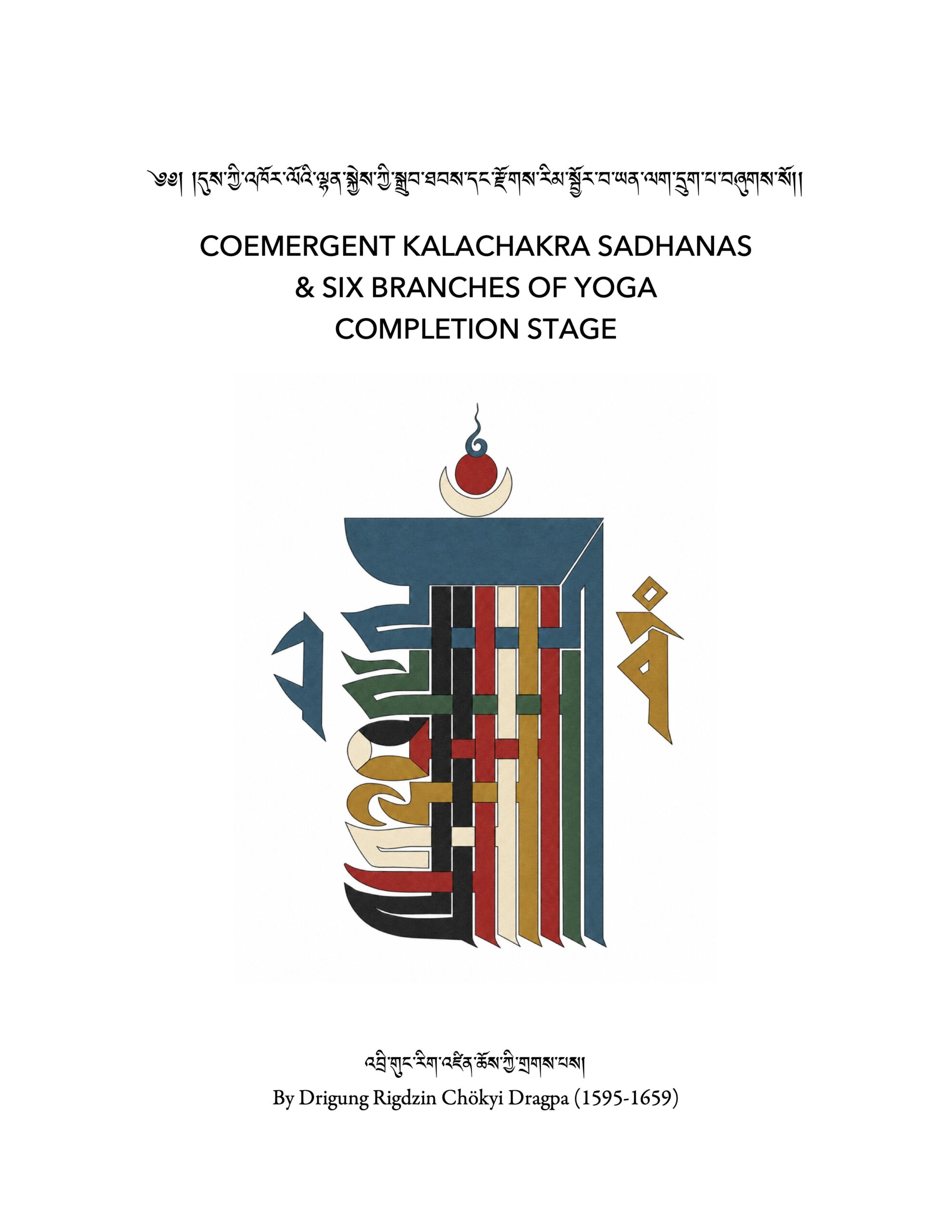
Coemergent Kalachakra Sadhanas & Six Branches of Yoga Completion Stage
Kalachakra means the “Wheel of Time.” Its teachings describe three interrelated dimensions. The outer wheel of time encompasses the universe, the cycles of the cosmos, and the movements of the elements. The inner wheel concerns the bodies, minds, energies, and experiences of sentient beings. The other wheel of time is the path itself. It reveals how the processes of the outer and inner worlds can be transformed into an extraordinary means of liberation from ignorance and afflictive emotions.
This new 153 page collection brings together essential practices from both the generation and completion stages of coemergent Kalachakra. It is a greatly expanded successor to the 48 page edition published in 2015. While retaining some material from that earlier publication, the present collection incorporates extensive revisions, expanded translations, and previously untranslated coemergent Kalachakra practices.
The collection opens with a history of Kalachakra and its transmission. According to this lineage history, Buddha Shakyamuni manifested in the enlightened form of Kalachakra and taught the tantra to Suchandra, the dharma king of Shambhala. The teachings were preserved in Shambhala through successive generations. Manjushrikirti composed the Condensed Tantra from the extensive root tantra, and his son Pundarika elucidated its meaning in the Great Commentary.
The tradition was later transmitted to India through Chilu Pandita and the great Kalachakrapada Manjuvajra. Among its important Indian lineage holders were Naropa, Kashmiri Somanatha, and Rahula Shribhadra. Their teachings entered Tibet through numerous streams of transmission. The traditions associated with Rahula Shribhadra and Somanatha became especially important for the generation stage practices of coemergent Kalachakra and the completion stage Six Branches of Yoga.
These teachings were later brought into the Drigung Kagyü and transmitted through Drigung Rigdzin Chökyi Dragpa, who lived from 1595 to 1659 and later became known as the first Chungtsang Rinpoche. A master of both the old and new translation traditions of Tibet, Chökyi Dragpa distilled the essential meaning of the sutras, tantras, and lineage pith instructions into texts intended for actual meditation and ritual practice.
Following the history are two coemergent Kalachakra generation stage sadhanas.
The first, Source of the Two Benefits, is a coemergent Kalachakra sadhana practice composed by Rigdzin Chökyi Dragpa and arranged by the second Drigung Chungtsang, Könchog Trinle Döndrub Chögyal. Its concentrated structure presents the essential elements of the generation stage in a practical form for recitation and meditation.
The second and more extensive practice is Bindu of Non-Duality’s Display: Sadhana and Mandala of the Coemergent Kalachakra According to Rahula Shribhadra’s Tradition. This text consists primarily of practice materials composed by Rigdzin Chökyi Dragpa. Lho Bongtrül Tendzin Nyima gathered and arranged these materials into a continuous sequence suitable for recited practice. In doing so, he brought together materials that had existed in separate and complex ritual texts, preserving the lineage while making the complete order of practice easier to follow without omissions or additions.
Bindu of Non-Duality’s Display includes the sadhana, mandala, and the complete empowerment rituals of the coemergent Kalachakra. Through deity yoga, mandala visualization, empowerment, offerings, praises, mantra recitation, and the gathering of the accumulations, the practitioner trains in the vivid appearance of Kalachakra and the mandala while recognizing their empty nature. Ordinary identity and perception are transformed into the enlightened body, speech, mind, qualities, and activities of Kalachakra. These generation stage methods prepare the practitioner to engage the subtle body and visionary practices of the completion stage.
The collection concludes with the non-dual Kalachakra completion stage according to the tradition of Kashmiri Somanatha. Known as the Six Branches of Yoga, this system does not approach the ultimate nature of mind only through conceptual analysis. It uses the inseparability of mind, subtle energy, and visionary appearance as a direct path to realization.
An essential feature of the Six Branches of Yoga is the cultivation of empty form visions. Practicing under conditions of both light and darkness, we begin to perceive appearances that do not arise from ordinary external objects. Among these are five-colored luminous bindus, rays, forms, and visionary displays. As meditative stability deepens, these appearances unfold progressively and become the experiential basis for the later branches of practice.
The visionary yogas are integrated with tummo fire and with the gathering, control, and stabilization of the subtle winds and other powerful energies of the body. Through breath control, retention, recollection, and meditative absorption, the normally dispersed energies of body and mind are brought into the central channel. The subtle body itself becomes a direct vehicle for realizing the ultimate nature of mind.
The collection contains four translations:
- Kalachakra History, from Lho Bongtrül Tendzin Nyima’s empowerment ritual for the Four Unsurpassed Coemergent Practices.
- Source of the Two Benefits: Coemergent Kalachakra Sadhana, composed by Rigdzin Chökyi Dragpa and arranged by the Second Drigung Chungtsang.
- Bindu of Non-Duality’s Display, composed primarily from Rigdzin Chökyi Dragpa’s practice materials and arranged for continuous recitation by Lho Bongtrül Tendzin Nyima.
- Six Branches of Yoga Non-Dual Kalachakra Completion Stage According to the Tradition of Kashmiri Somanatha, Rigdzin Chökyi Dragpa’s presentation of the Non-Dual Kalachakra completion stage according to Kashmiri Somanatha’s tradition.
The original Tibetan is presented alongside the English translations, with transliterations included in the sadhanas. This is a specialized vajrayana practice collection intended for qualified practitioners.