
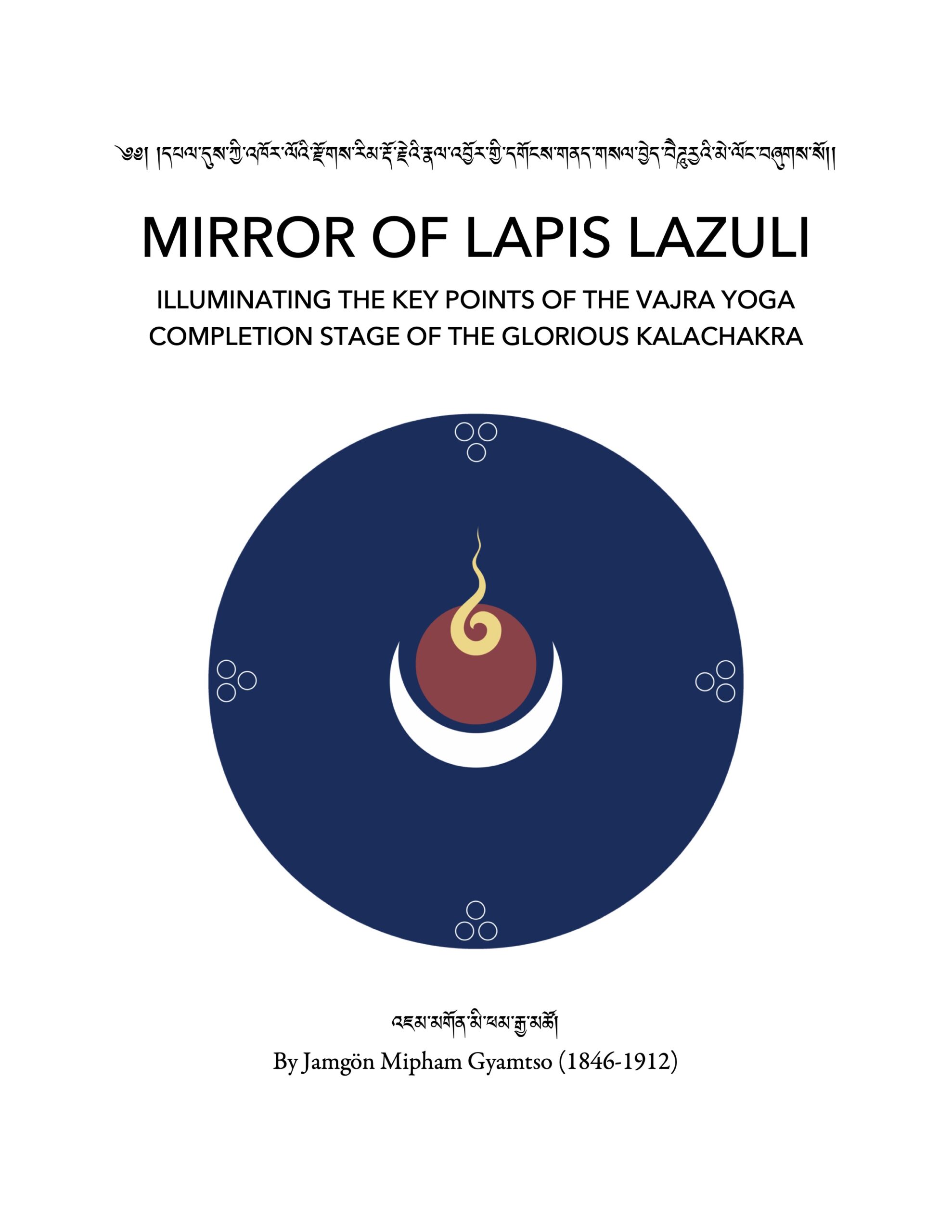
NEW 2026 – Mirror of Lapis Lazuli: Kalachakra Completion Stage – Jamgön Ju Mipham Gyamtso
Price range: $45.00 through $50.00
Description
Two Book Formats Available:
Physical Book
8.5”x11” Printed on Recycled Paper
Spiral Bound with a Clear Protective Cover
113 Pages
$50
Personalized PDF Ebook 8.5″ x 11″ (For 1 Person)
(Automatic Download Link After Purchase)
113 pages
$45
The Six Branches of Yoga are the completion stage of the glorious Kalachakra, the Wheel of Time. The Mirror of Lapis Lazuli: Illuminating the Key Points of the Vajra Yoga Completion Stage of the Glorious Kalachakra by Jamgön Ju Mipham Gyamtso (1846–1912) is a complete manual for this path, written by one of the greatest masters of the Nyingma tradition near the end of his life. This collection presents it together with two classic Indian root texts of the tradition, the hearing lineage verses of Kalachakrapada and the short text of the mahasiddha Shavaripa.
Following the ancient Six Branches of Yoga hearing lineages of Kalachakrapada and Shavaripa, Mipham based his manual on the two texts in which Jetsün Taranatha set out their practice in detail: the Instruction Manual on the Six Branches of Yoga Meaningful to See and the Measures of the Signs of the Six Branches of Yoga. In Taranatha’s writings, Meaningful to See sets out the practices in order. The Measures of the Signs describes the signs, experiences, and obstacles that arise from them. Mipham weaves the two into a single continuous sequence, so that each practice is followed at once by its signs, its measure, the experiences of body, speech, mind, and dreams, and the ways to clear what goes wrong. Mipham states that his manual contains every key point of this completion stage.
The main text by Mipham also has a remarkable history. He completed the Mirror of Lapis Lazuli in 1908 at the Chakrasamvara palace of Thrangu. Mipham’s handwritten manuscript was kept inside the reliquary stupa of Zhechen Gyaltsab Pema Namgyal and had never been copied. In 1936, during the upheaval of the times, the sacred objects were taken out for safekeeping. A later scribe requested that the manuscript not be sealed inside again, received it into his own hands, and copied it onto a wooden writing slate with great faith and joy.
In terms of practice guidance, Mipham begins with the ground. The nature of all phenomena is the sugata essence of luminosity, which the tantras call the great indestructible life-force. Through the movement of karmic winds and thoughts, this is not seen and beings wander in confusion. The Six Branches of Yoga bind those winds so that luminosity is seen directly, without conceptual deduction or fabrication. They are arranged as the yogas of the three vajras. Withdrawal and concentration are the yogas of enlightened body. Pranayama and holding are the yogas of enlightened speech. Recollection and meditative absorption are the yogas of enlightened mind.
Withdrawal is taught through the three isolations, the key points of posture that bind each of the ten winds, the gaze, and the key points of mind. In the yoga of the night, practiced in a dark room, the signs of smoke, mirage, fireflies, and the butter lamp arise. In the yoga of the day, practiced beneath a cloudless sky, come blazing, moon, sun, the Rahu eclipse, lightning, and the bindus. Mipham explains fixed and unfixed signs, the experience called the descent of the vajra, and the recognition of luminosity in sleep. The measure of withdrawal is to see a black line as fine as a hair within the central channel. Concentration then stabilizes the empty forms until the great bindu appears with all ten signs complete and the forms of the Buddhas are seen within it.
Pranayama brings the winds into the central channel through vajra recitation, the gentle breath, and the rough vase breath. Here Mipham gives a clear account of what occurs as the winds gather, including the obstacles of transference and emission, and explains how all the appearances of samsara and nirvana arise from the four bindus. In holding, the winds and mind dissolve into the indestructible bindu, tummo blazes, and the sound of the nada arises. Recollection draws up melting bliss through the four joys, relying on the three mudras according to capacity, and brings the eight signs of the completion stage. Meditative absorption unites the mahamudra of empty forms with unchanging great bliss. As the winds cease, the twelve bhumis are attained in sequence. Mipham writes that by this path, “Buddhahood is actualized in a single short lifetime of the degenerate age.”
This manual is especially relevant for dzogchen practitioners. Mipham was himself a master of the great perfection, and he explains the Kalachakra completion stage in a way that those who practice tögal will find immediately accessible. The path proceeds through posture and gaze, the yoga of darkness, and the yoga of the cloudless sky. Bindus, rainbow lights, chain links of light, and the forms of the Buddhas within the bindus arise in direct perception and are not imagined. Mipham observes that the appearances of empty space and of the bindus of primordial wisdom are similar to what the great perfection tantras explain as the lamp of the blue expanse and the lamp of the empty bindu. He presents the entire path as directly seeing the luminosity of reality, and he instructs that whatever arises be sustained as spontaneous experience, without regarding it as a fault or a quality. In the words of Taranatha that he passes on, empty forms are “directly seeing the self-appearance of luminosity.” For dzogchen practitioners, the detailed accounts of signs, measures, winds, and obstacles offer a precise map of closely related territory. For Kalachakra practitioners, they show how naturally this path opens into the view of the great perfection.
The manual closes with the practice of all six branches in a single session and a comparison with the six branches taught in the Guhyasamaja and in the Approach and Accomplishment of the Three Vajras of the mahasiddha Orgyenpa. Throughout, Mipham passes on Taranatha’s practical advice:
“Merely seeing the empty forms is not enough. The way of pointing them out, the way of mixing them with the path, and the way of enhancing them must be done without error.”
The collection contains three translations:
- Six Branches of Yoga Pith Instructions, by Kalachakrapada.
- A Short Text on the Six Branches of Yoga, by the mahasiddha Shavaripa.
- Mirror of Lapis Lazuli: Illuminating the Key Points of the Vajra Yoga Completion Stage of the Glorious Kalachakra, by Jamgön Mipham Gyamtso.
The original Tibetan is presented alongside the English translations to facilitate transmission, study, and practice. This is a specialized vajrayana practice text intended for qualified practitioners.
Additional information
| Choose Book Format | PDF Ebook, Physical Book |
|---|
Related products
-

Sambhogakaya Medicine Guru
Price range: $40.00 through $45.00 Select options This product has multiple variants. The options may be chosen on the product page -

Coemergent Hevajra and the Six Dharmas of Naropa
Price range: $20.00 through $25.00 Select options This product has multiple variants. The options may be chosen on the product page -

Yamantaka’s Fire Razor of Ultimate Repelling
Price range: $25.00 through $30.00 Select options This product has multiple variants. The options may be chosen on the product page -

Trilogy of Space from the Khandro Yangtig – Longchenpa
Price range: $25.00 through $30.00 Select options This product has multiple variants. The options may be chosen on the product page