
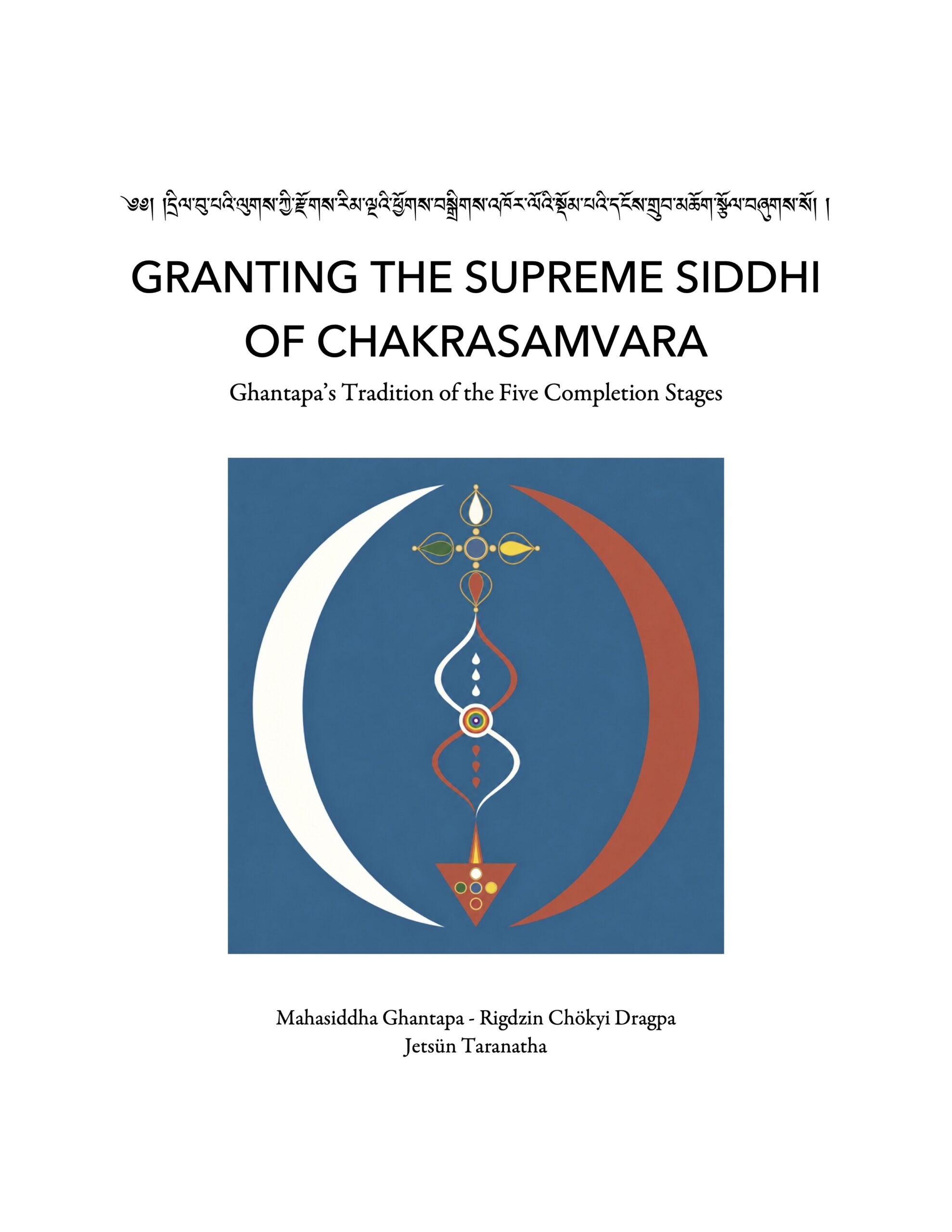
NEW 2026 – Granting the Supreme Siddhi of Chakrasamvara – Ghantapa’s Tradition of the Five Completion Stages
Price range: $40.00 through $45.00
Description
Two Book Formats Available:
Physical Book
8.5”x11” Printed on Recycled Paper
Spiral Bound with a Clear Protective Cover
101 Pages
$45
Personalized PDF Ebook 8.5″ x 11″ (For 1 Person)
(Automatic Download Link After Purchase)
101 pages
$40
Granting the Supreme Siddhi of Chakrasamvara: Ghantapa’s Tradition of the Five Completion Stages brings together five texts on the completion stage practices of Chakrasamvara. These teachings share important ground with the Six Dharmas of Naropa, including tummo, illusory body, dream yoga, and luminosity. They develop these practices through the distinctive methods of Ghantapa’s Chakrasamvara lineage, with its meditations on the vajra cross, the four mudras, and the five-colored bindus. Together, they offer a way to deepen Chakrasamvara practice beyond the generation stage, bringing deity yoga into direct relationship with the subtle body and the realization of coemergent bliss and emptiness.
Ghantapa was one of the great mahasiddhas of India, renowned for his realization and transmission of Chakrasamvara. His teachings are the source of the principal Chakrasamvara lineage practiced in the Drigung Kagyü tradition. The five completion stages preserve his distinctive approach to gathering the subtle winds and mind, awakening primordial wisdom, and realizing the inseparability of bliss and emptiness.
The collection begins with two works by Rigdzin Chökyi Dragpa (1595–1659), the first Drigung Kyabgön Chungtsang. Their placement reflects the collection’s grounding in the living Drigung Kagyü experiential tradition. Concise and directly oriented toward practice, these texts offer the most immediately relevant entry into the teachings for practitioners within this transmission. They connect the familiar forms of Chakrasamvara meditation with the deeper completion stage yogas, providing both practical instructions and a recitable expression of the path.
Mother Tantra Chakrasamvara Completion Stage Practices According to the Realization of the Mahasiddha Ghantapasets out the five stages in a compact and systematic form. The first two stages, self-blessing and the vajra cross, prepare the mind and subtle winds. The third, filling the jewel, presents the main practice through the four mudras. The fourth, Jalandhara, enhances the path, and the fifth, the inconceivable stage, introduces the nature of mind. Detailed visualizations are joined with direct instructions on luminosity and emptiness, bringing the experience of the subtle body into the realization of mahamudra.
Rigdzin Chökyi Dragpa’s Bestowing Supreme Siddhi presents the visualizations of the five completion stages as a supplication. Beginning with devotion to the guru, it proceeds through impermanence, karma, renunciation, bodhichitta, calm abiding, special insight, and empowerment. Its completion stage passages include the central channel and bindus, tummo, vajra recitation, sleep and dream yoga, the four mudras, illusory body, and luminosity. Written to be understandable and convenient to recite, it brings the crucial points of the path into a form that can be recollected repeatedly, joining experiential meditation with devotion and aspiration.
By Jetsün Taranatha (1575–1634), there are the Instructions on the Five Stages of Glorious Chakrasamvara. This amazing work expands upon the completion stage practices, explaining how to establish the visualizations, develop stability, and bring the sense faculties and their appearances into meditation. Taranatha discusses differences among earlier instructions and clarifies alternative approaches, preserving details that help illuminate the more concentrated presentations. His supplementary teachings also explain how to continue the meditation between sessions, enter sleep with awareness, and develop practice within dreams.
Ghantapa’s Five Stages of Glorious Chakrasamvara and Commentary on the Five Stages of Glorious Chakrasamvara complete the collection with its Indian source teachings, from the mahasiddha Ghantapa himself. The root text presents the stages in beautiful concentrated verses and prose, emphasizing the guru’s blessing, the relationship between subtle wind and mind, the four mudras, and the inconceivable nature of coemergent realization. The commentary, which comes from Ghantapa and the oral tradition held by his students, elaborates upon the generation and completion stage meditations, including practices focusing on the seed syllable, bindu, and nada. Together, these works allow readers to study the foundational presentations alongside their development in the Tibetan experiential tradition.
Throughout the collection, the practices of the channels, winds, and bindus are merged with the view of ultimate emptiness and the mahamudra realization. Bliss becomes a means of recognizing the nature of mind, and appearances become supports for realizing coemergent bliss and emptiness. These teachings deepen the connection between the deity’s enlightened form, the experience of our own body and mind, and the realization expressed in the Chakrasamvara sadhanas.
The collection complements Joyous Dance of Bliss and Emptiness: Coemergent Chakrasamvara Practice and Instructions by developing its completion stage dimension. Tibetan texts accompany the English translations, with recitation transliterations included in Bestowing Supreme Siddhi. Prepared for qualified vajrayana practitioners, the five works support study, practice, and transmission within a living tradition of experiential realization.
Additional information
| Choose Book Format | PDF Ebook, Physical Book |
|---|
Related products
-

Secret Sadhanas of the Guru Who Holds the Power of Life
Price range: $20.00 through $25.00 Select options This product has multiple variants. The options may be chosen on the product page -
Yamantaka’s Fire Razor of Ultimate Repelling
Price range: $25.00 through $30.00 Select options This product has multiple variants. The options may be chosen on the product page -
Coemergent Vajrayogini
Price range: $35.00 through $40.00 Select options This product has multiple variants. The options may be chosen on the product page -
Luminous Wisdom Space Expanse: A Written Record of Khandro Nyingtig Liberating Instructions
Price range: $35.00 through $40.00 Select options This product has multiple variants. The options may be chosen on the product page